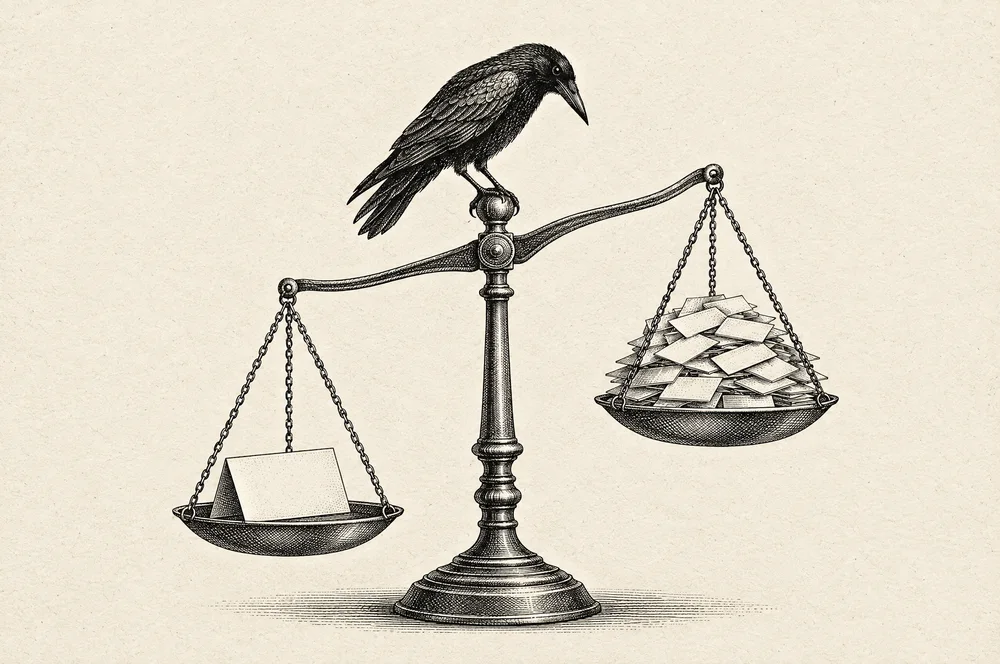
A running ad is a clue. Not a verdict.
What an ad library can tell you, what it leaves out, and how to turn a promising observation into a useful test.

An ad stays visible. You save it. The folder is called “Winners.”
That last step is where a useful observation becomes a claim you cannot defend.
A public ad record gives you something worth investigating: a piece of creative, an advertiser, a destination, and whatever timing or status information the source provides. It does not give you the advertiser’s full economics. A long run cannot, by itself, establish profit. Neither can a crowded folder of variations.
I would keep the ad. I would change the folder name.
Start with the sentence you can support
Write down exactly what you saw, including when and where you saw it. “This creative was visible in the library on the dates I checked” is a different statement from “This creative ran continuously between those dates.” The space between two observations is still a space.
Then separate three things in your notes:
- Observation: the material you can inspect and the source that supplied it.
- Interpretation: your explanation for why the advertiser might be using it.
- Test: the decision your own evidence could help resolve.
That small distinction makes the research more useful. You can revise an interpretation without losing the original observation, and you can disagree about a mechanism while looking at the same evidence.
Follow the promise past the click
Suppose an ad leads with a compact product demonstration. Its page opens with the same use case, answers the obvious compatibility question, and places the relevant proof beside the purchase choice. This is an illustrative scenario, not a reported campaign result.
The useful finding would be the continuity: the page lets someone investigate the promise that earned the click. “Product demos work” throws away that detail. Copying the opening shot would throw away even more.
Trace what each part contributes. What does the first frame help someone recognize? What uncertainty does the demonstration remove? What remains unanswered when the person arrives on the page? Does the offer ask for a commitment the ad never mentioned?
Those questions give you a mechanism to examine without pretending to know its return.
Make the test smaller than the inspiration
An attractive ad can tempt you into replacing the hook, format, offer, and destination together. If the result changes, you are left with another attractive object and a weak explanation.
Choose one uncertainty. For the illustrative demonstration, it might be: does showing the product’s fit earlier help qualified visitors understand whether it is for them? Keep the purchase terms and destination consistent while you compare that opening with the existing one.
Before running anything, specify the outcome that would change your decision and the signals you need to interpret it. A more compelling opening could bring more attention while attracting the wrong people. A purchase result also needs enough context to rule out a changed offer, a broken page, or a different audience mix. The appropriate test depends on your business and measurement setup.
The research has done its job when it improves that question.
Keep collecting ads. Preserve their dates, destinations, and context. Give the strongest ones a second look. Just leave enough room between “interesting” and “proven” for the work that connects them.
My preferred folder name is “Worth understanding.”
End of dispatch 001